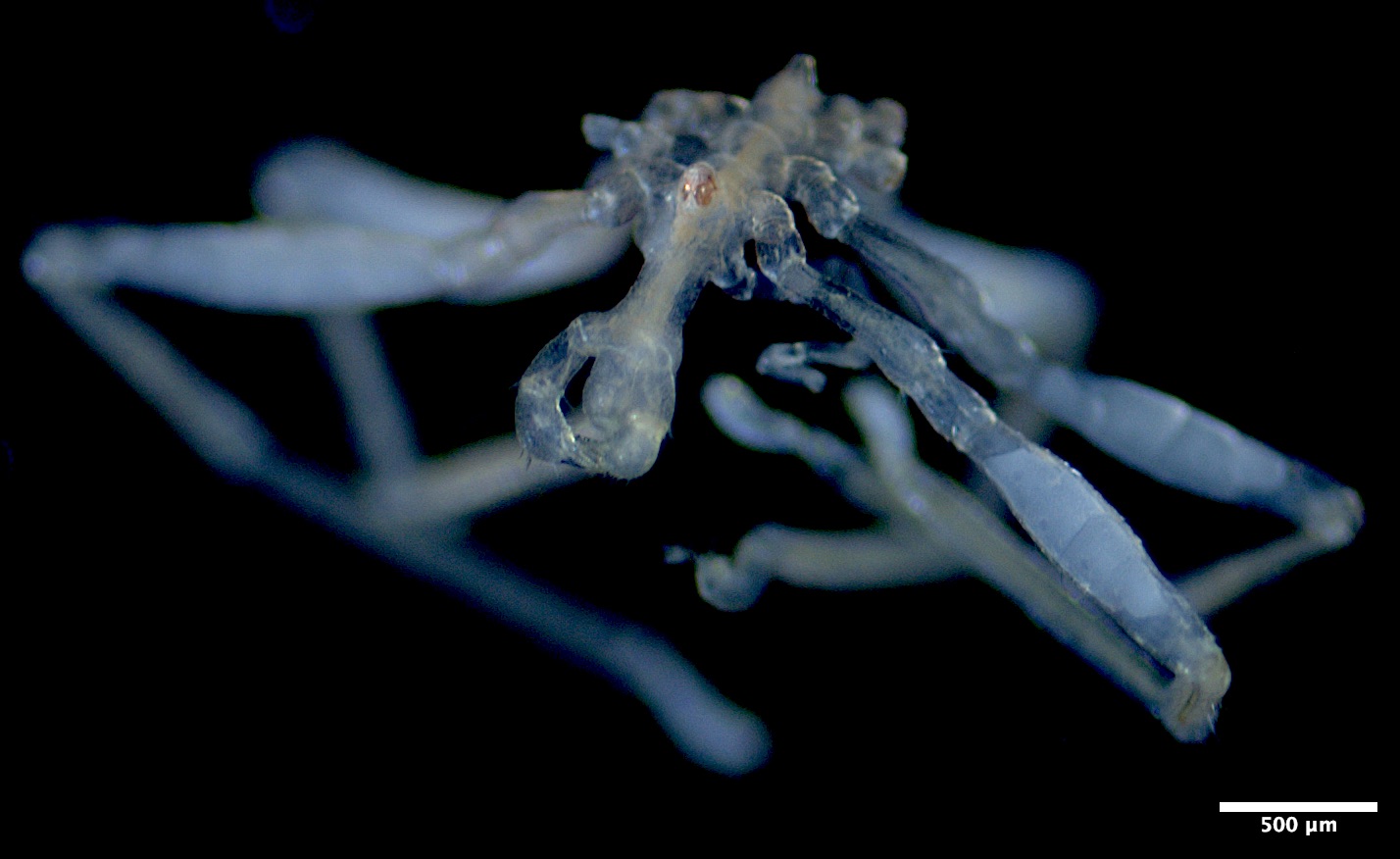
The ocean apparently has a tiny animal that barely grooms itself, lives on somebody else's body, and carries an entire collection of smaller freeloaders. I had several questions, starting with: How many levels of parasite can one creature reasonably support before somebody starts charging rent? And then I learned there was a second newly described sea spider that researchers watched removing a hitchhiking skeleton shrimp with its own delicate little grooming tool. The Salish Sea has been keeping very strange secrets.
Scientists working with the University of British Columbia recently described two sea spider species from coastal waters around British Columbia: Tanystylum kiixin and Callipallene pilosuspedes. Their research, published in Organisms Diversity & Evolution, marks the first new sea spider species described from the Salish Sea region in nearly a century, according to UBC. That doesn't mean the animals only started existing recently. It means science finally had the observations and comparisons to recognize them as species in their own right.
I contacted UBC because the headlines were wild but the real behavior sounded even more interesting. Press officer Alex Walls helped obtain answers from researcher Cormac Toler-Scott, who had studied the specimens in detail. I wanted to know what could distinguish one tiny marine spider from another, why an animal might live covered with minute passengers, and what people could actually learn about local marine life without scooping creatures out of their homes.
You can't identify them by guessing which one looks weirder
Toler-Scott explained that identifying sea spiders by eye is difficult because they are small and their defining features can be subtle. His team used scanning electron microscopy, a tool that builds high-resolution images from electrons reflected off a sample, to examine structures the naked eye cannot reliably resolve. They compared those details against earlier species descriptions and drawings. When the patterns didn't fit, the possibility of something undescribed became more compelling.
But the microscope wasn't the whole verdict. The researchers also compared genetic sequences, working with evolutionary relationships across already documented species. Anatomical evidence and phylogenetic analysis together supported the conclusion that these were genuinely new-to-science species descriptions. The moment of discovery sounds less like a movie scene where a scientist leaps from a chair and more like a quiet accumulation of tiny details that refuse to match the old reference books.
I find that beautiful. A tiny mouth part, the shape of a leg, the absence of a grooming feature, a sequence of DNA—and suddenly a piece of the familiar coastline holds an animal people hadn't formally identified. The shoreline hasn't changed. Our understanding of what's living there has.
Meet the sea spider who lives on a hydroid
Tanystylum kiixin spends its life clinging to Plumularia setacea, a hydroid: a colonial marine invertebrate related to anemones and jellyfish. It is an ectoparasite, feeding on the bodily fluids of its host while holding on with slow-moving, grasping legs. Toler-Scott told us the team found multiple generations of these sea spiders living on a single hydroid plume. It's possible some barely leave their host at all, because the branching structure provides food, shelter from currents and protection from predators.
Now add another layer. Sea spiders can host tiny symbionts and parasites of their own. Toler-Scott explained that some are using the spider's body as a place to live and may be eating bacteria on its surface rather than feeding on the spider itself. The animal is living on a hydroid. Tiny organisms are living on the animal. The food chain has become an apartment building and apparently nobody is checking the lease.
Kiixin's problem isn't that it refuses to tidy up. The appendages called ovigers, which in sea spiders are associated with carrying eggs, are small and not very dexterous in this group. Other species can use similar appendages as cleaning tools, but this one is poorly equipped for the task. Toler-Scott said heavy parasite loads can affect movement or mating in extreme cases, though the team doesn't think that happens often in these animals. 'Covered in parasites' may sound catastrophic to us; life down there can be more complicated than that.
The other one has red eyes and excellent housekeeping skills
Callipallene pilosuspedes is no less strange. UBC describes its red eyes, leg spines and a three-lipped mouth framed by tiny sensory structures. If somebody handed me a fictional monster with those specifications, I would accuse the writer of trying too hard. But this isn't fiction. It is marine biology, and it happens to be operating at a size most of us will never notice.
This species has more dexterous ovigers with structures that help it groom. Toler-Scott's team watched a specimen actively remove a skeleton shrimp that had attached itself to its body. The difference is a useful reminder that even close neighbors in the marine world can have different toolkits and relationships. The researchers found only one known specimen of C. pilosuspedes in the work described by UBC, so one observation isn't a license to invent a full species-wide personality. What they witnessed was striking enough without embellishment.
And no, the research is not evidence of hairy marine spiders chasing swimmers at night. These are tiny creatures associated with marine habitats and underwater organisms. The most useful lesson here is how much biodiversity remains overlooked along coasts people think they know well.
The name Kiixin deserves a real explanation
The name Tanystylum kiixin refers to Kiixin, an ancient Huu-ay-aht village site near where the specimens were collected around Bamfield on Vancouver Island. Toler-Scott said the name is pronounced roughly 'Kee-hin' and evokes the sound of waves crashing at the foot of the village. The researchers chose it to recognize and pay respect to the Huu-ay-aht First Nation.
That deserves more care than treating a beautiful Indigenous place name as an exotic flourish in an animal story. Kiixin is a place of living cultural significance, not just the inspiration for a scientific label. A responsible feature should get the pronunciation, community and geography right, and should not turn a species discovery into an invitation to visit a culturally sensitive site without guidance or permission.
Where to look for the little world you usually walk past
Toler-Scott told us public docks can be a wonderful place to observe local marine biodiversity, especially in spring and summer when algae and hydroids gather on submerged surfaces. The 'fouling' communities around dock structures can include sea spiders, skeleton shrimp, nudibranchs, sponges and creatures you might ordinarily need deeper water to see. Parts of a dock stay submerged year-round, making them homes for organisms that would struggle with exposure in a shallow tidepool.
That is a recommendation to look carefully, not to pry animals from pilings, collect specimens, scrape growth off infrastructure or enter unsafe areas. Stay where public access is permitted. Follow local dock rules and respect working boats and private property. Observe rather than disturb. If you want an up-close look, museums and marine-education programs can show these worlds more safely than an impromptu underwater expedition.
I started with a sea spider that can't clean itself. I ended up thinking about what it takes to notice a creature no larger than the details we usually ignore. A researcher looked at a tiny body and kept asking questions until it revealed something new. Somewhere just under the surface, an animal is clinging to a hydroid, and another one is waving off a skeleton shrimp. I think that makes the coastline feel wonderfully less ordinary.
Original reporting: Researcher Cormac Toler-Scott, written answers provided through Alex Walls, University of British Columbia, November 2, 2026. UBC News, September 23, 2026: https://news.ubc.ca/2026/09/new-sea-spiders-discovered-salish-sea/ . Research published in Organisms Diversity & Evolution.
Cover: Callipallene pilosuspedes specimen photograph by Cormac Toler-Scott, University of British Columbia. University press images furnished through UBC research correspondence for this editorial story.
Sources and photography credits are detailed above and within the reporting.
What are the two new Salish Sea spider species?
Researchers named Tanystylum kiixin and Callipallene pilosuspedes. Cormac Toler-Scott explained how the team compared their anatomy under high-resolution microscopy and examined gene sequences. These are tiny marine arthropods, not land spiders making a break for the beach.