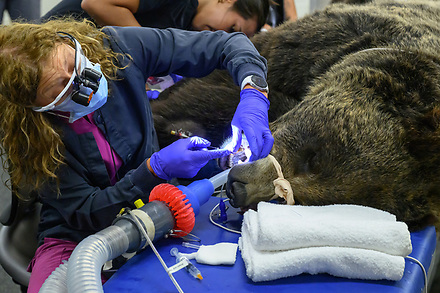
A grizzly bear with a broken tooth sounds like the opening line of a joke. At Washington State University, it became a two-hour dentist appointment, a van ride across campus and a serious question: how do you help a 500-pound patient get back to eating comfortably?
When I read WSU's account, I couldn't get past that transportation detail. The patient was Adak, an 11-year-old grizzly at the university's Bear Research, Education, and Conservation Center in Pullman. Staff suspected he'd damaged a canine while wrestling with his sister.
I have a lot of questions about sibling relationships in the bear world. But the tooth wasn't funny.
THE PATIENT WHO NEEDED AN ENTIRE TEAM
The broken tip exposed the tooth's pulp, the sensitive tissue inside. Dental problems can interfere with bears' eating and everyday health, so staff took it seriously. Adak was already scheduled for anesthesia, giving veterinarians a chance to examine his mouth and arrange treatment without an unnecessary extra anesthetic event.
On August 20, 2026, handlers prepared Adak and took him in a transport van to WSU's Veterinary Teaching Hospital. A specialist veterinary dentist joined an anesthesiology team, faculty and students for a root canal lasting roughly two hours. They examined the root with X-rays, cleaned the canal, sterilized and filled it, then checked that the filling was complete.
I am impressed by anybody who can concentrate on dental work while the patient is approximately the size of a vending machine.
THE QUESTION I SENT BACK TO WSU
The October news reports made me laugh. But after the jokes, I wanted to know something less spectacular: how was Adak doing now? A bear can't sit across from you and say the tooth still aches.
So I emailed the university. On November 11, photographer Ted S. Warren sent me original answers from the Bear Center and Dr. Raelynn Farnsworth, chief medical officer of the Veterinary Teaching Hospital.
The Bear Center reported that Adak was eating normally and acting like himself the very next day. He has continued doing well, remaining active and comfortable, with no observed signs that the treated tooth is bothering him or interfering with his usual activities.
That's a detail I love. The people who know this bear can read his everyday behavior. His appetite and his interactions are part of how they understand his recovery.
WHY SAVE A GRIZZLY'S TOOTH?
Farnsworth told me the thing that surprises the veterinary team, even when they expect it, is the scale of everything: the bear's feet, head and teeth.
That size makes extraction a significant undertaking. Removing the tooth would leave a large site that needs time to heal, with dietary changes and follow-up care. A root canal preserves the functional canine without an extraction wound. WSU's original reporting explains that extractions may involve eight to twelve weeks of modified diet, whereas successful root-canal treatment can allow normal feeding almost immediately.
A canine tooth is not a souvenir. For Adak, it is part of how he eats and lives. Saving it was an animal-welfare decision, not a stunt.
THE PEOPLE BEHIND THE BEAR STORY
The Bear Center says dental trouble is its bears' most common health problem. Rough play and chewing on enrichment objects can take a toll. Catching an injury early makes it more likely that veterinarians can save the tooth.
This operation depended on staff who noticed something was wrong, specialists who knew what to do, and a teaching hospital willing to coordinate an unusual case. Students also got to see what excellent veterinary work looks like when no one person has every answer.
The headline is a grizzly getting a root canal. What stays with me is that a team of people put enormous care into helping one animal have an ordinary next day.
Adak didn't have to become a different bear. He just got to go back to being himself.
And that might be the best possible ending to a story about a 500-pound dental patient.
Original reporting: WSU Bear Research, Education, and Conservation Center and Veterinary Teaching Hospital chief medical officer Dr. Raelynn Farnsworth answered PNW Passport questions in a November 11, 2026 email relayed by WSU photographer Ted S. Warren. Earlier procedure reporting: WSU Insider, October 27, 2026. Watch WSU’s original video of the procedure ↗. The possible sibling-wrestling injury is not confirmed.
The story does not end when I hit publish.
Every Monday I send a letter about the stories we discovered, the people behind them, and a few very good reasons to leave the house.
Love, Larie ❤️