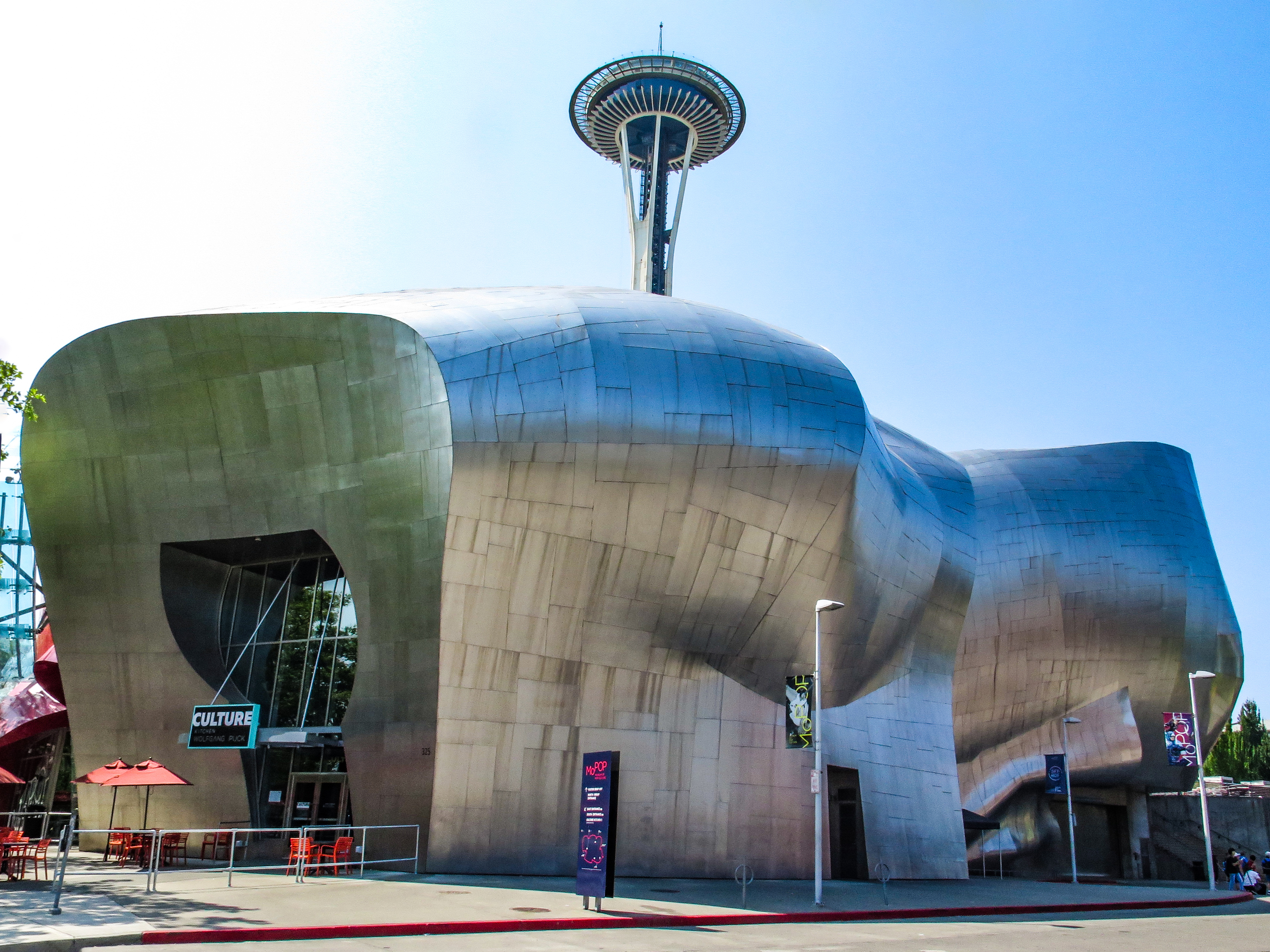
There are perfectly respectable ways to tell the story of Pacific Northwest music. You could start with a timeline, a row of gold records, and somebody solemnly saying “the Seattle sound.”
Or you could start with a guitar smashed at a college dorm party in Olympia and a musician who once dressed up as a weeping Norway spruce.
I vote for the second door.
On Saturday, November 21, Seattle's Museum of Pop Culture (MOPOP) opens two long-term exhibitions: Puget Sound Stories: Seattle Music + Beyond and Jimi Hendrix: West Coast Seattle Boy. Together they hold more than 350 objects, ranging from instruments to stage clothes and family history. I asked MOPOP's Caroline Hall what people would actually find. Her answer confirmed that both Kurt Cobain's battered Univox Hi-Flyer and Neko Case's remarkable tree suit are part of the opening display.
The guitar survived the party. Barely.
October 30, 1988. Nirvana is playing a Halloween-themed gathering in dorm K208 at The Evergreen State College in Olympia. This is before the band becomes a household name, back when a basement or dorm-room show could have an entire musical future unknowingly pressed into its walls.
MOPOP's collection record says Cobain destroyed a circa-1970s Univox Hi-Flyer onstage that night — the first guitar he demolished during a performance. Now the surviving broken body is a museum object, its sunburst finish surrounded by old stickers and drawings. The museum acquired it in 2000 from Nirvana fan Brad Roberts, Hall confirmed.
There is another human detail in the collection archive that stopped me: attendee Ben Lattin picked up a fragment of the guitar neck and wrote to his sister about the show. The surviving letter is an ordinary person trying to explain an extraordinary night while it was still just a night.
That is my favorite part of a good local history. Most people don't know when they're standing in the first paragraph of something big. They just know the music was loud and somebody broke a guitar.
Not everything in Seattle music history wears flannel.
Then there is Neko Case's Weeping Norway Spruce Tree Suit. The musician designed and wore it for the artwork of her album Neon Grey Midnight Green. MOPOP confirmed that the actual suit will be on view too.
There's a lot of humanity in that pairing. One object is what's left after somebody destroys an instrument. The other is the result of somebody deciding, yes, I will become a tree for the art. Between those two choices there is a surprisingly useful history of artists figuring out how to be seen, heard and remembered.
Also on the museum's confirmed roster: an Ann Wilson concert dress from 1978, shown on a 1979 magazine cover, and artifacts connecting groups as different as Bam Bam, Heart and Merrilee Rush. The larger Puget Sound Stories exhibition looks beyond the grunge story to jazz, hip-hop, folk, and the communities that made those sounds possible. It would be a disservice to the region to suggest a couple of distorted guitars explain the whole thing.
The other exhibition, West Coast Seattle Boy, turns toward Jimi Hendrix's early years in Seattle and includes items from before the rest of the world knew his name. MOPOP's November 9 announcement describes the two galleries as connected histories rather than competing shrines.
How to go without guessing.
Both exhibitions open to the public Saturday, November 21, 2026, and are included with regular museum admission. MOPOP's opening-day program also lists live music, a turntable roadshow, film screenings and conversations; specific program times are on the official opening-day page and may change.
MOPOP is at 325 Fifth Avenue North in Seattle Center, near the monorail terminal. The museum currently lists daily hours of 10 a.m. to 5 p.m. It uses plan-ahead admission pricing, so check the actual ticket total for your visit instead of relying on somebody else's screenshot. November 20 is an earlier preview for members; November 21 is the public opening.
This is a reported preview, not a firsthand museum review. I haven't walked the new galleries. What we have are MOPOP's artifact records, its current exhibition plans and direct answers from its communications team. Once the doors open, the visitors and curators get to add the next layer.
And if you go, look beyond the famous names. Somewhere between the broken guitar and the person who dressed as a tree is a much bigger story about this place — about the fans who saved things, the people who made them, and the curious impulse to keep a weird little piece of music history so somebody decades later can still ask why.
Reporting + image note: MOPOP communications manager Caroline Hall confirmed the objects and guitar acquisition in a November 16, 2026 interview by email. We also checked the museum’s November 9 announcement, its guitar collection record and the public opening-day program on November 19. MOPOP has approved selected press-kit photographs for limited editorial uses, but those particular files could not be delivered. The contextual photo above is used instead under its separate Creative Commons license. We have not attended the exhibitions; this is a reported preview.
If you want to go
Public opening: Saturday, November 21, 2026 · MOPOP, 325 Fifth Avenue North, Seattle. Both new long-term exhibitions are included with general admission. November 20 is the separate members’ preview.
Hours, admission prices and individual activities can change; check the museum before traveling. No admission has been reserved.The story doesn’t end when I hit publish.
Every Monday I send a letter about what we discovered, the people behind the stories, and a few good reasons to leave the house.
Love, Larie ❤️