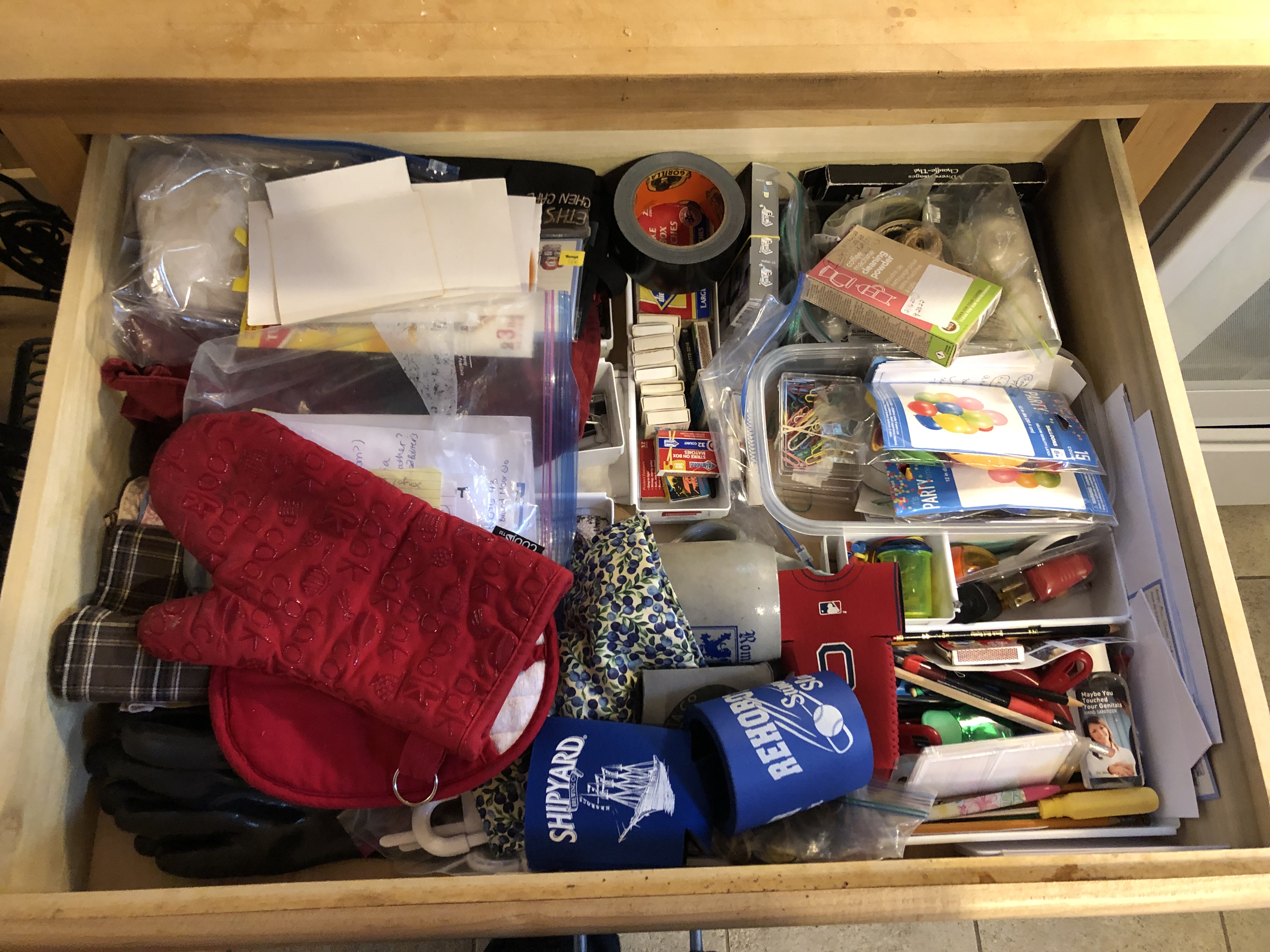
There is a drawer in almost every house that nobody should be allowed to open when company comes over. It contains an expired coupon, three batteries nobody trusts, a key to something no longer in our possession, and a charging cable that may belong to a camera from 2009. We all know the drawer. We all pretend we'll organize it next weekend.
Portland artist Michael Apruzzese looked at that private little disaster and saw a portrait of a city. So he started asking strangers whether he could photograph theirs.
The first problem, obviously, is that this sounds like a spectacularly weird thing to ask somebody. A stranger wants to come inside your home and inspect your mess? In Portland, apparently, the answer was yes. More than 200 times.
His approach was equal parts art project and neighborhood experiment. He posted flyers around town announcing that he'd photographed your junk drawer and inviting you to get involved if he hadn't yet. There was a QR code. There was a question mark hanging over what would happen next. The flyers accumulated by the hundreds, then the thousand. People started volunteering, which says something lovely about Portland's willingness to entertain a curious idea.
Apruzzese didn't wake up one morning as a professional junk-drawer inspector, a job title I regret is not on our city payroll. According to Willamette Week's May 2026 reporting, he was laid off from a job at a retirement home the previous year. He'd been making electronic music as Rad! Bummer! and suddenly had time to explore visual art. A creative detour turned into an excuse to visit homes, listen to people and examine the physical evidence of ordinary life.
He found what you might expect: keys, tape, cords, batteries, scissors. And then he found what you might not expect. A whoopee cushion. A tiny squirt gun. Objects that probably made perfect sense when they were placed there and have since lost the entire courtroom case for their continued existence.
But this isn't a book that says, look at these silly people and their silly stuff. Its strongest idea is gentler. A junk drawer doesn't tell the complete truth about anybody, and guessing too confidently from the contents would be unfair. Yet it's hard not to recognize yourself in those little collections. We save things because we might need them. We keep objects because they belonged to somebody. We throw the mysterious cable back in the drawer because identifying it requires more emotional energy than we've got on a Tuesday.
What surprised Apruzzese, as he told Willamette Week, was how different every drawer looked and how little wealth seemed to dictate the contents. Fancy houses still had junk drawers. Their chaos wasn't necessarily more sophisticated. An expensive countertop does not magically stop a rubber band from ending up beside an old battery. Finally, an area of modern life where everyone can achieve equality through complete disorganization.
The project became a 192-page photography book called Junk, published through Apruzzese's own magnificently named company, Blah Blah Blah I Love You Anyway Publishing. By late September 2026 it was available online and in a handful of local shops, including Music Millennium, Vivienne Culinary Books and Secret Room. Pricing and retail availability can change; check the publisher before going on a hunt of your own.
There's also a tenderness in the way the project was made. People opted in. They let a stranger see what they usually keep closed. Some supplied remarks for the book, and they could decide how publicly they wanted to be identified. That matters. The drawers may look like a hilarious mess, but the subjects are people extending trust, not specimens under glass.
I think that's why this idea works better than a perfectly styled portrait of Portland. Cities are usually photographed from the outside: skyline, bridges, neighborhoods, somebody's aggressively photogenic latte. Apruzzese photographed something people ordinarily hide and somehow made a picture of the city feel more human. We're all carrying a few things we don't know what to do with. Sometimes they fit in a drawer.
And if you're suddenly motivated to clean yours? Maybe don't. At least take a photo first. You might discover that your little pile of objects tells a story you haven't heard in years.
Find the book: Junk by Michael Apruzzese, https://www.blahblahblah.love/ ; Instagram @junkdrawerbook for examples. Original coverage and quotes: Rachel Saslow, Willamette Week, May 26, 2026, https://www.wweek.com/arts/visual-arts/2026/05/26/michael-apruzzese-wants-to-see-your-junk-drawer/ ; follow-up September 30, 2026, https://www.wweek.com/arts/visual-arts/2026/09/30/photo-book-junk-peeks-inside-portlanders-junk-drawers/ . This feature is based on published interviews, not a new interview by PNW Passport.
Cover photograph: An illustrative Maine cabin junk drawer by Hportfacts5 / Wikimedia Commons, licensed CC BY-SA 4.0, https://commons.wikimedia.org/wiki/File:Maine_Cabin_Junk_Drawer.jpg ; license https://creativecommons.org/licenses/by-sa/4.0/ . Article layout may crop image; image retains its original license and is NOT an Apruzzese project photograph.
Sources and photography credits are detailed above and within the reporting.
Where can you find Michael Apruzzese's book Junk?
Apruzzese turned more than 200 Portland junk drawers into a photography book called Junk. Check the artist's publisher, Blah Blah Blah I Love You Anyway Publishing, for current availability. The image at the top of this article is illustrative, not one of his project photographs.