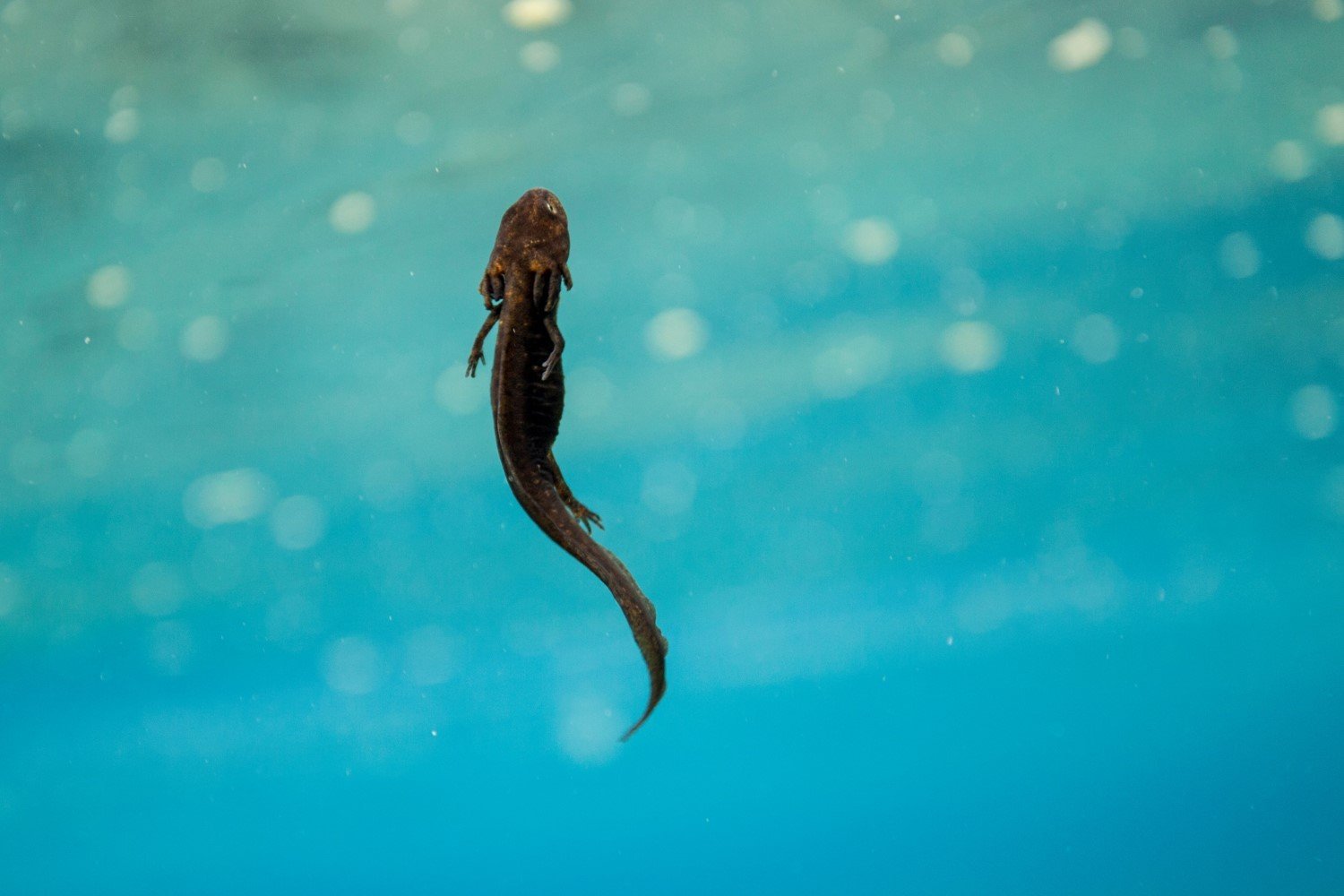
We go to Crater Lake for that impossible blue water. We take the pictures, stand at the rim and marvel at a place that barely seems real. Meanwhile, scientists have been getting INTO that water every summer, looking under rocks for one of its smallest residents.
This year they didn't find a single one.
The Mazama newt is a distinct, dark-bellied subspecies of the rough-skinned newt. It lives nowhere else on Earth. For nearly 20 years, National Park Service teams have snorkeled at designated sites, checking on the population. They counted 35 in 2023, four in 2025 and zero in summer 2026, according to federal records released by the Center for Biological Diversity on November 10.
I wish zero simply meant someone looked in the wrong corner. It might. A survey is not a census of every animal in the lake, and scientists have NOT declared the newt extinct. But the direction of these numbers is frightening.
HOW DID THIS HAPPEN?
Here's the maddening part: humans helped create the problem. Nonnative fish were brought into Crater Lake in the late 1800s, and signal crayfish were introduced in 1915 as food for those fish.
Mazama newts evolved with few predators. Compared with their rough-skinned relatives, they have much less of the toxin that normally helps discourage animals from eating a newt. The crayfish eat the newts, chase them out of their hiding places and compete for the snails and other small creatures they need for food.
As lake temperatures have warmed, crayfish have expanded. In the 2026 survey, researchers found crayfish at every study site—and no newts. Southern Oregon University warns that losing the lake's small invertebrates could also affect the clear blue water we all recognize.
At Phantom Ship, park scientists trapped crayfish for three years. Their numbers increased tenfold. That's how difficult this introduced-predator problem may be to reverse.
There's a legal clock running, too: the U.S. Fish and Wildlife Service is due to decide by November 20 whether the newt merits federal Endangered Species Act protection. No final decision has been verified as of this article.
TWENTY-SIX REASONS TO KEEP TRYING
At the Oregon Zoo, where the public can't see the behind-the-scenes newt lab, scientists and keepers are working with the National Park Service and Southern Oregon University to breed the animal for the first time in human care.
In July, Oregon Zoo keeper Kaley McClung described the first hatchlings as “exciting and nerve-wracking.” In a September KLCC interview, zoo conservation specialist Julia Low said the breeding effort might have taken five years; they achieved it in nine months. By early November, 26 larvae were developing. They're still in human care; nobody has released this generation into Crater Lake.
National Park Service biologist Dave Hering and university students are studying a small pool on Wizard Island as one possible future reintroduction site, evaluating food, crayfish, trout and habitat conditions. The effort could take 20–30 years. It's careful, uncertain work, and there isn't a movie-version happy ending to report yet.
But 26 living newts are a start.
If you want to help, the Oregon Zoo Foundation supports the recovery program, and the zoo asks Oregonians to prevent and report invasive species through the Oregon Invasive Species Hotline. The lab is not a visitor attraction.
I've seen endless pictures of Crater Lake's blue water. I'd really like future visitors to inherit the little life underneath it, too.
REPORTING SOURCES + HOW TO HELP
Reporting: Original PNW Passport synthesis of National Park Service research, 2026 survey results released by the Center for Biological Diversity, Southern Oregon University reporting and Oregon Zoo conservation work. Zero survey-site sightings are not proof of extinction; 26 larvae are still being raised in human care.
- 2026 survey results, Center for Biological Diversity
- Southern Oregon University: fieldwork and breeding updates
- Oregon Zoo: first newts hatched in human care
- Oregon Zoo conservation guide
- National Park Service on invasive crayfish
- Report invasive species in Oregon
The story does not end when I hit publish.
Every Monday I send a letter about stories we discovered, people behind them, and a few good reasons to leave the house.
Love, Larie ❤️